Search

Content

1 comments

"No soy guiri, soy de Baza"


"Those who dream by day are cognizant of many things that escape those who dream only at night”

- Edgar Allen Poe, as found on my sugar packet at d'Platos (in Spanish). My weekly dose of sugar packet wisdom.


Yes, readers, I realize it's been a while since my last post. Well, more than a while. However, if I had all the time in the world to update my blog I wouldn't have much to write about, would I? I’m not going to lie, winter break threw me off a bit. But, to catch you up a bit...


The Spanish are very proud of their home-towns, or “pueblos,” and surely won’t miss the chance to tell you that they are not in fact from Granada, but hail from a “pueblo” outside the city. Their evident attachment to their town, combined with a strong sense of family, is what seems to draw these Spaniards back to their hometown many-a-weekend. While my roommates often stay in the city, I won’t pretend that they don’t go home to be with their family and friends in Baza more than I would have guessed for 24 and 29 years olds. Not to mention that, according to David (29), that’s still not enough in his mother’s eyes.


Rebeca, David and I out and about in Baza


The weekend before my big adventure to Berlin (queue next post), my roommates Rebeca and David invited me to their hometown of Baza. About an hour's drive outside of the city, Baza is a small town quietly situated in a valley of the Sierras distinguished by cave-homes, black handprints, and a strong sense of community. At this point, I suppose you’re wondering about the black handprints. You can find them on most of the buildings in the center of town; a constant reminder of the “Fiesta de Cascamorras,” a festival that takes place in Baza and the neighboring town (Guadix) every September. This is Spain we’re talking about, and that something as random as black handprints covering the city is the result of a festival shouldn’t come as a surprise.


A brief background of Cascamorras: In 1490, a worker from Guadix found a statue of Virgen de Piedad (Our Lady of Mercy) in Baza. Encouraged by Guadix, he unsuccessfully attempted to carry the sacred statue to his hometown. From the Guadix-Baza contention over the ownership of the Virgen arose the tradition of the Cascamorras. Every year, a person from Guadix is commissioned to run through the town of Baza in an attempt to “retrieve” the statue. If he takes the image without stain, which is to say without being covered in paint, he is allowed to take the image back to Guadix. So as to stop the Casscamorras from stealing the sacred Virgin, everyone in Baza covers themselves in black paint and tries to coat the Cascamorras in black handprints. The result: black handprints over everything and everyone, and what seems to me like an overall good time. Why cant towns in the States have such obscure traditions that beings everyone together, running around like crazy, painted people? Oh, the beauty of Spanish festivals.
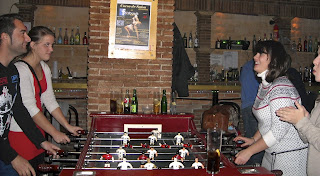
Playing Foosball at a bar called "Feisbuuk"
around the small table in the living room, brasero by our feet and fire (“alumbre”) crackling at our backs. Chocolate, as prepared in Spain, is very, very rich. Rebeca and I both admit that we can’t even drink it- only use it to dunk our hot, crispy churros. And we were not lacking those. There was an entire bag-full, and after about two I was done for. But then Rebeca’s mom would chime in and I found myself with another churro sitting in my belly. Rebeca’s brother, JuanRa: “I can usually only eat about five, then I’m stuffed!” Well, I’d hope so, JuanRa.


As for to my weekend in Baza, no, I didn’t get to experience the Cascamorras festival first-hand (Get it? First-handPRINT). Unfortunately, it seems like all of the cool Spanish festivals are celebrated during the Summer months. However, Baza does have a sort of wine festival during in December, which I was able to experience. Just like every Spanish festival is usually based on a Saint or Catholic tradition, the wine festival coincides with the “Día de Santa Bárbara” to commemorate the conquest of Baza by the Reyes Católicos and expulsion of the Moors from the city.


I suppose what I’m trying to say is that the people of Baza found a reason to celebrate. The town plaza catered to the various citizens that made their home-brews (I’m obviously a beer lover- is wine even “brewed”?), and to those that came thirsty. There was also traditional Spanish dancing- however, as flamenco is about as far as my knowledge of Spanish dancing goes, I can’t say exactly what it was.


With Rebeca's friend Gema, her sister and brother at the wine festival


Rebeca, David and my taste test of the wines didn’t end there. They took me to a typical Spanish bar owned by a friend of David. White-washed walls, small windows, plain table-and-chair setup, and a huge fireplace with “careta” roasting on an open flame. What’s “careta” you might ask? Well, it was on the menu that night, and I was willing to try just about anything. It must be a living-in-a-foreign-country-thing. After a bit of the newly made wine poured from small clay pots (and some of the wine from last year- the good stuff courtesy of David’s friend), we delved into the “careta.” Pigs face, people. Pigs. Face.


And it tastes just like you’d expect. The cheek just sort of, explodes in your mouth. I wouldn’t call it meat, more like... crunchy fat. I’m cringing right now. Then there’s the ear. David (en español): “It’s my favorite part, it’s just like a chip!” Chip, hah! Cartilage is chewy, let’s leave it at that. After getting a few laughs from the expressions on my face of utter disgust (“¡qué asco!”), we ordered steak. Now there’s something I’m familiar with.


There were more than a few questionable things I ate that weekend. Blood sausage, something weird that was in my calamari (not the nice little circle calamari, either), and why does the fish have to have bones? Which leads me to Spanish mothers and food. Rebeca’s mother, who I now associate with all Spanish mothers (and I apologize for the generalization), was constantly at the ready to feed us. I suppose it’s not unlike Omi, come to think of it. But where the Spanish parts way with the German is the olive oil.


Rebeca’s mom: “How does your mother usually cook fish?”

Me: “Well, she usually cooks it in the oven... sometimes we grill it...”
Rebeca’s mom: “Better fried!” (and proceeds to pour all the fish, bones and all, into a fryer full of olive oil)

Yes, it is tasty... But oh, boy. The amount of fried food I ate. I was eating salad for a week to detox. As I recall, Sunday morning consisted of the Spanish classic: Churros con chocolate and the entire family and I huddled

I’ll leave you with Sunday’s lunch. A typical “Spanish” experience if I’d every had one. Every Sunday, Rebeca’s family goes to her abuela’s home for paella. I say home instead of house because, well, Rebeca’s abuela lives in a cave. Yes, una cueva. It’s actually rather typical in Baza and cave-homes outline the town. Although it wasn’t my first “cave” experience (I had been to a tetería- tea house- in a cave the night before), it was a sight to see.

Above: The cave-home, with white-washed walls and various little rooms, was not at all what I expected. No, it was a true “home,” and besides the walls not being straight had all of the same comforts of a house. The neat things about these cave homes is that the temperature is naturally regulated year-round no matter the temperature outside.

Rebeca’s grandmother sitting in a chair by the fire, her mother bent over the fire with an enormous paella pan filled to the brim, perched atop the flames. Oh, right, and in a cave no less.


So there I was: In a cave, sitting at the table with Rebeca’s family, eating paella.

Kate’s gone native.

Read more »
0 comments

Filmosofía: Photography course.

"¿Qué es lo que hace a este conjunto algo singular y reconocible?"
-What every photographer should ask himself/herself (though, maybe not in Spanish)
It seems that there is not a direct translation in Spanish for, "I'm excited." You can say, "tengo (muchas) ganas de ir..." but that's not always as effective. Those online Spanish translators will use "emocionado" or "animado," but they all sound a bit strange when talking about a photography course. Whether or not I could express my excitement in Spanish, that didn't change the fact that I was very much looking forward to the intensive 16-hour photography class (8hr/day) that I took the other weekend at Filmosofía SLNE. My flatmate, Rebeca, recommended the class when I told her I was searching. She works at Filmosofía, a local company owned by a couple that offers photography and film-making classes. Rebeca herself gives classes on movie production.

Sixteen hours, all in Spanish, covering virtually all of the topics of basic digital photography. I'm sure you can guess that it was a lot of information crammed into one weekend. The history of photography, using your camera in the manual function, lighting, editing on the computer- the list goes on. I'll just touch on some of what I learned that really opened my eyes (that doesn't mean I'll be brief-- so if you're not a photo nerd, I'll try to give you another post to read shortly ;) ...
Zoom. Contrary to popular belief, a lens with zoom does not a better photo make. According to Rubén Serra, director of Filmosofía, and something I'd like to think is true; All of those people you see walking around nowadays with huge lenses- just about 100% of the time they don't know what they're doing. Professional photographers, unless they are capturing photos of animals or sports, do not use zoom lenses. In fact, using zoom does not only make the photo flatter (más plano), but also lessens the quality of the picture. Whereas with fixed lenses the light only has to travel through five lenses, light passes through twelve lenses twelve in a zoom óptica. You can't beat fixed lenses, say Rubén. 18mm for landscapes, 35mm for a full-body portrait, 85 for portraits and, a-la Cartier-Bresson, the star of the fixed lenses: the 50mm.

So I guess you can guess what I'm asking for for Christmas.

My days of using "Auto" are long gone. After a review on the aperture and shutter speed, I'm back in the game. Not only are my photos crisper and hardly ever over-exposed, but I feel so much more in charge of the photo I make... I mean, duh. But something I wasn't aware of was that Auto really does not work indoors and in direct sunlight. For these environments, along with harsh shadows and cloudy days, you have to change the settings for the white balance. Inside light will no longer be orange, and direct sunlight won't turn out blue. Hah!
Another setting I wasn't aware of- ISO. Set to 200 for night-time pictures to avoid grainy photos.

Speaking of using the camera in manual- often you can't make the shutter speed as fast as you want because the aperture won't open far enough. When it comes to the aperture on a lens, you get what you pay for. Most lenses don't go past 2, which allows for VERY little depth of field. Mine barely goes under 4. Still does the trick most of the time.
One thing I realized about this photo class is I suddenly have a very long, very expensive shopping list. On that list are filters and a tripod. I've always wondered how people can get the shutter speed to be low enough to take those photos of moving water in which the water looks smooth and flowing. You have to control the amount of light that enters the camera to achieve such a slow shutter speed in daylight. By using a shaded filter and a tripod, less light enters the camera allowing you to slow down the shutter speed and capture said photo. There are also polarized lenses when you don't want a reflection, or graded filters that shade the sky but not the ground (to avoid overexposure of the sky). Pretty neat stuff.

Composition. We quickly covered the topic (as with just about everything), and I realized that what I was doing without thinking is actually all part of the guidelines of photography composition.
Take for example, the rule of thirds. I knew positioning the subject in the center of a photo wasn't appealing to me, but I had forgotten about the rule that says you should place the most important elements of a photo along the lines (vertical or horizontal) that divide the picture in three parts each way.
Then there's the direction the eye moves along the photo, guiding the photographer in how to position the various elements. We read from left to right, so our eye tends to move first from the top left down to the bottom right. If you look at magazine ads, the majority of them place the product on the bottom righthand corner, in hopes of leaving a lasting impression.
The "interference" is usually placed in the bottom lefthand corner. Looking through my photos, I have a tendency to do this. In fact, the picture I took right before coming to class had an out-of-focus flower in that position as the "interference." But who knew there were guidelines saying to do the same thing?

I'll just list a few more rules I thought were interesting to take into account: The "ley de la mirada" says that the photographer should leave space in the direction that the subject is looking. The space above the subject's head should be treated as if he/she is wearing a halo-- leave the space open! I often forget this, then look back at my photo and realize the subject is wearing a tower of the Alhambra as a hat, for example.
Obviously, these are just guidelines; it's up to the photographer to break the "rules" and make the photo unique.

Lighting. In portrait photography, I won't forget this: "Cuanta más grande, más blanda" and "cuanto más pequeño, más dura." Translation: The bigger the light, the softer the shadow, and the smaller the light, the harsher the shadow. Think about it- the sun's light is a "small" light far up in the sky. The shadows created by the sun are very harsh and defined. If the photographer wants a softer shadow, he/she must make the light "bigger" using an umbrella, soft box, or simply bounce the light of the flash off the walls. When it comes to soft and hard light, it's not about the brightness of the light, it's about the size.
The integrated flash shouldn't be used as the key light. A "good" portrait always needs at least two forms of light: a key and fill light. If you use the integrated flash, you shouldn't be able to tell it's there-- for example, if the sun is directly behind the subject causing a harsh shadow over his/her face- you can use the integrated flash.
For whoever made it to the end of this post- Congratulations! Now you get to hear the teacher's criticisms of my work. We went to the Mirador de San Nicolás to test the lessons from class on the field. Our work was later judged in class. The main criticism that I really took to heart was that the area in focus always has to be greater than the area in focus, and there cannot be a "bandera" (flag) effect in the photo (first an area out focus, then out of focus, then out of focus again). I have a tendency to go a little overboard with playing with depth of field, and occasionally the area out of focus outweighs the focused area and isn't "visually appealing." That's right, the teacher said to me, "este no sirve para nada" (it's not worth anything- to the professional artistic community, that is) to a few of my photos. A pretty harsh criticism to take. That's not to say that I didn't defend my work-- I'm not one to think that just because it doesn't follow the rules, it's not worth anything. Either way, I'm making a conscious effort to work on that. Who knows, maybe that style will be "in" amongst the artistic community in the future, and I'll be the forerunner. Take that, Rubén. :)


PS-
When I made it home on Sunday night, I immediately bought a better photo editor- Aperture (Apple's photo-editing software). I can now take pictures in .RAW- much better quality than .JPG (I didn't know of the difference in quality, and now I'm scared for my previous photos if the day comes when I want to make prints!).

Interesting site for coming up with color combinations if you can control the colors in your photo: kuler.adobe.com. In order to evoke a sense of calm, use like colors. By contrast, complimentary colors evoke stress.

For more photos from my time at Filmosofía, visit my facebook page!
Read more »
1 comments

Apagalaluh!

Happy Thanksgiving! I was fortunate enough to celebrate this very important and very American holiday with
20 other Americans and every type of Thanksgiving food imaginable (including some atypical Thanksgiving foods such as haggis, courtesy of the Scots). Our feast was complete with canned cranberry sauce and pumpkin pies made with canned pumpkin, all thanks to Eddie's dad who visited that week. We even had the football game streaming on a computer. Not far off from Thanksgiving at home, discounting the fact that I was in Spain and the 20 Americans weren't family. Then again, those Americans were all loud, a lot of fun, and a little intoxicated... Perhaps not so far off after all.

Thursday after work, I headed down to Torre del Mar in Málaga- a coastal town reminiscent of the Jersey shore. Eddie's lucky enough to have a town house right on the beach... He'd better be prepared to see a lot of me in the Spring.
My dish was cauliflower with cheese sauce. Let me rephrase that; A mountain of cauliflower with cheese sauce. I'm certain the man
at the frutería and I grossly overestimated the amount of food I should have made. Then again, I think this was mainly due to the fact that of the 20 Americans, 20 brought a dish that could feed 20 people and we all had a taste of everything (well, we tried to). However, I'm not complaining. Everyone knows Thanksgiving leftovers are the best!
Well, maybe all besides cauliflower... I've been eating the damned stuff for the past week and only finished the last of it today. Hooray!

Friday I made it back to Granada just in time for... A second Thanksgiving feast! I wasn't sure
I'd be celebrating Thanksgiving in Spain one time, let alone twice! Another Thanksgiving and another TWO turkeys. In true American fashion, we overestimated the amount of food... Again. An entire turkey wasn't carved! I'm guessing that was one of those rare cases of too many Thanksgiving leftovers (sobres).

Gobble Gobble! Or should I say, "Apagalaluh!"-- Apaga la luz; say it fast with an Andalusian accent, and you sound like a turkey :)
Read more »
0 comments

"La Jamsa" خمسة

Can I just say that in order to write a blog- literally, to type the letters- means that my fingers have to be exposed to the frigid icebox that is now my apartment. In other words, my ten little dedos and I hope you appreciate our efforts.

Thursday night is quiz night (a.k.a. trivia) at Café Piaf, my new favorite tapas bar. Naturally, I went to the bar with a group of French girls. The only catch is- the questions are in French, and then in Spanish.
Let's just say, the French and Spanish don't know their American geography very well. Yet, somehow I ended up looking like the tonta (idiot). By a stroke of luck, the question was: What American city is the Pentagon building located? The answer: ARLINGTON, Virginia, of course!! My town! While everyone was so sure that the answer was Washington, DC- I knew the real answer and would take our team to victory. Only, it turned out that anyone living outside the United States (and some living in the US- cough, cough Michelle)- including the quiz judges- thinks the Pentagon is in Washington, DC. Oh, well. I still have my pride!

Another weekend, another baking experiment. This time, chocolate chip banana bread:
Michelle and Casey, two of my American friends in Granada, came to my piso for what turned out to be a baking and cooking fest.
Yes, Saturday was my first attempt (and relatively successful attempt at that) at making an authentic tortilla de patatas, also known as tortilla española. A very simple recipe- just potatoes, eggs and onions. The catch: you have to flip the tortilla with a plate back into the saltén (pan) to cook the other side. It may not have been the prettiest tortilla, but that's not what matters now, is it?


Stéphanie invited me to my second Moroccan dinner in Granada... Only this time it was a Moroccan feast. Stéph really does have the hookups around town when it comes to Moroccan friends and cuisine.
Stéph and I:
To put it lightly (and use a new vocabulary word), ¡había una barbaridad de comida! ("There
was a ton of food!"). In fact, I mistook the appetizer for the entire meal. Little did I know that lamb with rice, cous cous with vegetables, tea and nuts, and finally ice cream were awaiting us. I'm not sure if it is just Stéph's friends or all Moroccans, but they are especially generous.
The "appetizer:"
Omar and Mehdi with the second course:
Amazing cous cous:
Afterwards we gave our bellies a rest and played some games that required more than a few embarrassing performances from the losing teams, which I hate to admit was mainly my team. Yes, I was the only American in the room and yet somehow I could not name all of the "Friends" actors... And yet the Moroccan and British in the room could. My bad! In any event, my team found ourselves dancing to the "Las Ketchup" song (well known throughout Spain- do you know it?) as our castigo (punishment).
Our team (ironically named "The Winners"):

In reference to the title of this blog post, "La Jamsa," also known as the "Mano de Fátima" (Hamsa, the hand
of Fátima), is often given incorrect significance. The host of the dinner party, Omar, told us that "La Jamsa" is translated to "cinco" or "five" in English- a number that in Islam is connected to the image of an open hand. La Jamsa is believed to be a symbol of protection against the "evil eye" in many societies, but Omar told us that it simply represents "las cosas buenas" (the good things) that Islamic culture associates with an open hand: happiness, peace, etc.

I'd say I have a lot of those "cosas buenas" in my life right now.

Currently obsessed with: Breaking Bad (a television show on AMC). Currently listening to: Alexnder Ebert's Truth (from the show, surprise surprise).
Read more »
0 comments

Día de la infancia.


Veronica and Cristina with some of the kids from class. Happy "Día de la infancia!" Next week... Turkey hands!
Read more »
0 comments

Flipao.

Rebeca said today that despite the fact that Granada doesn't have enough jobs, it is the perfect city. Virtually everything is within walking distance because Granada isn't too big. It's not too small either; there are plenty of new bars to discover and more than enough stores to tempt the passerby (even if that passerby only earns 700€/mo.) In the same vein, a saldo (salary) of 700€/month is more than enough to live comfortably in the city. Rent is affordable and going out for a beer (2€) with free tapas is very reasonable. Buying food at the grocery store is cheap, especially the healthier fresh foods. I'd say Rebeca's right on point.
There are, however, a few things I could really do without. While it's true that I can walk anywhere in the city center and usually opt out of taking the city bus, there are a few (four, specifically) things that I would just LOVE to be spared from for just one day on said walk:

1) Dog poop. It's everywhere. Are Spaniards above picking up their animal's feces? I mean, the animals already don't have to be on leashes, none of them are fixed, and they piss on every wall or corner they get their sites on. There's no grass, anywhere. The least you could do is pick up that shit (in the literal sense of the word). But no, they leave the pile in the middle of the sidewalk for people to step in and spread over the entire path. I would, just once, not have to inspect the ground or get random whiffs of animal feces, thank you.

2) Cigarette smoke. Just one day, please spare me second-hand smoke while I'm walking outside where I usually prefer to breathe fresh air. If I'm not smelling animal poop, I can always count on cigarette smoke. It is Spain, after all. They can ban smoking in bars, but not on the streets. Oh well.

3) Beggars. Specifically gypsy beggars. By the cathedral, outside churches, along sidewalks. Trying to shove crappy pens or sprigs of lavender in your hand so you have to pay them. Spare me. If you give me something gratis (free) and proceed to ask me for money, I'll shove it back in your face. I think just the fact that there are so many people asking for money every day (which, given the economic circumstances and the fact that Granada is a city, is understandable) has just gotten under my skin. If I'm sitting outside at a restaurant, the last thing I want to be bothered with is if I want to buy a DVD from a pile of unorganized disks. I don't want any of those watches or sunglasses, they are shit. Now please leave me alone to finish my meal.

4) Those pushy Spaniards, and the slow ones... Both just as annoying. There's only so much room on the sidewalk, and I've discovered that you really need some practice in maneuvering your way through the various obstacles- specifically, people. It's especially prudent to have these skill sets with Spaniards, because they will stand their ground. First, there's the people that walk in groups and will not move for you to pass as you approach them. Then there's the inevitable stand-off, and as the foreigner I'm used to being the one to step off the sidewalk or wait for them to pass. But as my time here is teaching me, I can just as easily stand my ground. Although I might brush a few shoulders... Why should I be the one to move? Then, there are the elderly couples or elderly women with their daughters; both arm-in-arm. While I usually find this endearing and sweet, when I'm in a rush and they won't move to let me pass that sentiment is quickly forgotten. All I'm left with is... God damn it, MOVE!

So, to sum up: I'm sure I could do without the dog poop, cigarette smoke, gypsy beggars and sidewalk etiquette that I find in Granada (and Spain in general). But, echoing the words of Rebeca; this city is perfect in so many ways and I'm pretty sure I can deal with the few annoyances that come with such an ideal setup. I think I'm getting the hang of the dog-poop-beggar-slow-people-dodging that is required on my way to work each morning.

PS- For those wondering about the title of this post, "flipao" is the Andalusian pronunciation of "flipado" that roughly translates to "crazy." My roommates use this word all the time...
Read more »
0 comments

Mariiiiii...

"Mari" is short for "María," and since every other woman here is called "María"-something (María José, María Carmen, María María María!), it's a term of endearment that practically any woman will respond to-- caution, use among friends.

Let's move onto a familiar topic... Food. I live in Spain where the fruit and vegetables are so fresh, the fish and seafood abundant (and aslo very fresh), and the variety of food is so different from my "norm." I live with people who know their stuff in the kitchen and are more than willing to teach me the ropes or share their comida with little inexperienced me. However, that inexperience is quickly fading. Here's a little insight into what's been on my Spanish menu recently:

- Dessert Pizza: Tani's (Rebeca's friend) creation-- Pie crust used for pizza dough with a combination of onions sautéed in red wine and sugar baked with cream (nata) and goat cheese on top. So easy, and so scrumptious.

- Potaje de lentejas: A lentil stew courtesy of Rebeca and her talent for soups. Correction- potajes (stews). She's going to teach me the recipe before Christmas because I know it's perfect for Dad.

- Pan de carne (Meatloaf): Alright, not a "Spanish" dish, but I made it for the apartment. A little taste of home.

- Ground beef & red wine reduction, cauliflower, and zucchini: Yesterday's lunch, and a Rebeca and Kate original. We knew we had ground beef (leftover from the meatloaf) and lots and lots of vegetables that were going to be podridos (bad) pretty soon. So, we threw the ground beef in a pan with carrots, peppers, onion and garlic and let it reduce in red wine. I battered and fried the zucchini in olive oil, but the cauliflower was by far my favorite. After cooking the cauliflower, Rebeca covered it in cream, small chunks of Iberian ham and- ingeniously, ground nutmeg.

- Now, for the pièce de résistance- a meal of mariscos: Clams, mussels, shrimp (with their heads), salmon, swordfish, shrimp salad... a meal for champions! Can't forget the wine:

From L to R: Giovanni (Rebeca's boyfriend), Rebeca, David and Antonio:
As the night wore on, our bellies filled with seafood, our glasses never empty, and listening to music ranging from classic flamenco to Axel Rose, we played a board-game (in Spanish) called Party & co. Trying to lip-read spanish phrases and act out or draw Spanish words was entertaining, to say the least. Naturally, I was on the winning team. Later, we moved onto a game played with dice called Mentiroso. If a player rolls a 9, the next player has to roll a higher number- if they don't, they lie (mentir) and hope the next player doesn't catch their bluff. If they do, you get an "M" and so on until you are a "Mentiroso." All in all, a great night with my Spanish family.

Next up (I hope): The renowned tortilla de patatas, a Spanish classic... And I'm told easy enough. The plate-pan-flip worries me a bit, I'll admit.

Listen to this: Shiny Soul, by Fuel Flamenco http://www.youtube.com/watch?v=USf9maa8_ro&ob=av2e
Read more »

Search

Followers